Business Administration and Management
Adds operational depth and analytical tooling to a general management degree.


When a product reaches a customer, dozens of decisions got it there: what to buy and from whom, how much to make, where to hold it, how to move it, and how to know any of that is working. Supply chain management is the discipline of making those decisions well. This minor gives you the operations, analytics, and project management skills to do it, and they apply to nearly every organization that produces or delivers anything.

Two things distinguish this minor:
It's quantitative, not conceptual. You work in Excel from the first course, move through applied statistics and regression, and finish in business analytics using the tools organizations actually make decisions with. Operations and Supply Chain Management covers procurement planning, forecasting, capacity management, quality management, inventory control, and the information technology that ties them together. Productivity, Work Systems, and Management of Work teaches you to assess an operation, find where it's losing time or money, and systematically redesign how the work gets done.
It's fully specified. Every course is required. There are no electives, no tracks, and no substitutions, which means every graduate of this minor has the same demonstrable skill set. That's unusual, and it's a genuine advantage when you're explaining the credential to an employer.
A minor's value is in how it complements your major. Supply Chain Management pairs naturally with:
Adds operational depth and analytical tooling to a general management degree.
Demand forecasting and inventory planning sit directly behind the promises marketing makes to customers.
Inventory, working capital, and cost of goods are supply chain outcomes before they are financial statements.
The analytics sequence pairs with technical training to open operations research and systems roles.
An underrated fit. Central Florida agriculture runs on cold chain, logistics, and perishable inventory, and this minor is the business half of that problem.
The Supply Chain Management minor is 26 credit hours across seven required courses. There are no electives.
The Supply Chain Management minor is 26 credit hours across seven required courses. There are no electives.
| Course | Title |
|---|---|
| BUS 2217 | Principles of Management |
| BUS 2220 | Microsoft Excel for Business |
| BUS 3210 | Operations and Supply Chain Management |
| BUS 3320 | Applied Statistics and Analytics for Business |
| BUS 3650 | Project Management |
| BUS 4300 | Productivity, Work Systems, and Management of Work |
| BUS 4300 | Business Analytics |
The minor is taught in the Barney Barnett School of Business and Free Enterprise, which holds AACSB accreditation, and Central Florida's position as a distribution corridor for the Southeast puts working supply chains within reach of campus.

The minor maps onto defined entry points: procurement and sourcing, demand planning, inventory and warehouse management, logistics coordination, operations analysis, and project management. Because the coursework is tool-based rather than theoretical, those skills also carry into consulting, business analysis, and any operations function.
It also sets you up to keep going. Florida Southern's MBA offers a Supply Chain Management concentration built on Lean and Six Sigma processes, supply chain management, and operations management, and the Master of Science in Analytics extends the statistics and business analytics work into data science and business intelligence. Both are available through 4+1 early admission, which you can be considered for in your junior year and which lets you complete up to nine graduate credit hours before you finish your bachelor's degree, counting toward both.

More than any other minor, this one depends on getting the order right. Meet with the coordinator and your academic advisor before you file, and confirm how you will satisfy the Business Systems and Processes prerequisite.
Your academic advisor can assist with planning your schedule.
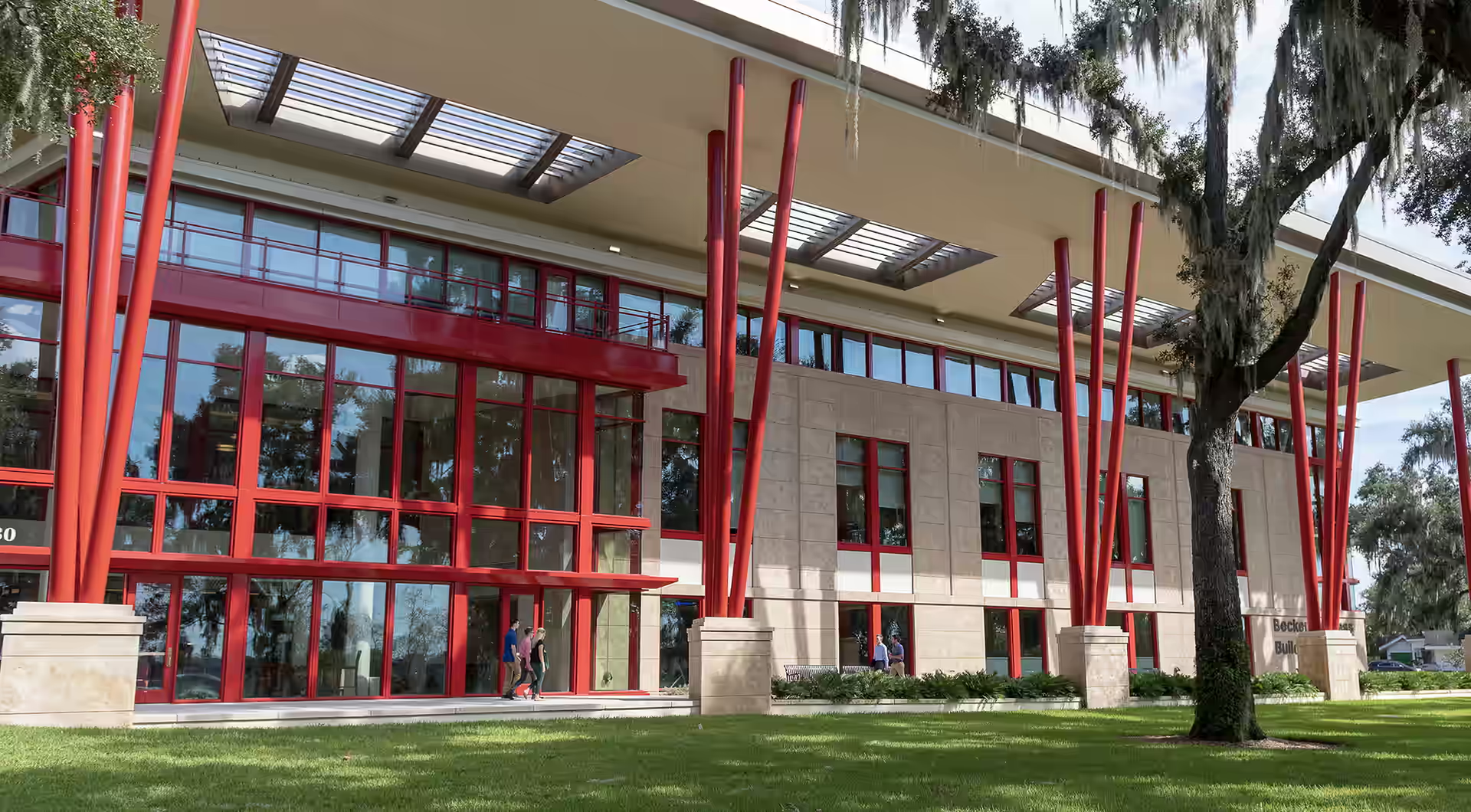
Return it to the Office of the Registrar on the second floor of the Buckner Building, or email it to registrar@flsouthern.edu. Entrepreneurship requires no departmental signature.
Requests are reviewed and updated in the FSC Portal within three to five business days, and you will receive an email confirmation at your FSC Mocs email.
Questions about the Entrepreneurship minor, or ready to declare?
This is a big decision, and we’re here to help you make the choice that’s right for the future you’re imagining. Choose a next step to explore the possibilities at FSC!