Honors College

Set Yourself Apart
You've worked hard, and it shows. Now it's time to join a community that will push you even further. Led by FSC's most distinguished faculty, the Honors College invites you to think deeper, question broadly, and collaborate across disciplines. You'll build the skills and connections to prepare for graduate study, competitive fellowships, and leadership in your field.
The application will open in October.
-
Top 10% of the Class
Each year, only about 10% of first-year students are invited to join the Honors College.
-
20 Credit Hours
Take up to 20 credit hours per semester at no extra cost.
-
2-Year Capstone
Complete an original research project alongside a faculty mentor.
-
4 National Fellowships
Honors alumni have earned NSF, Fulbright, Goldwater, and Truman Capote awards.
Honors-Only Opportunities
As an Honors student, you'll pursue the questions that matter most to you, working closely with faculty mentors who help you reach your goals.
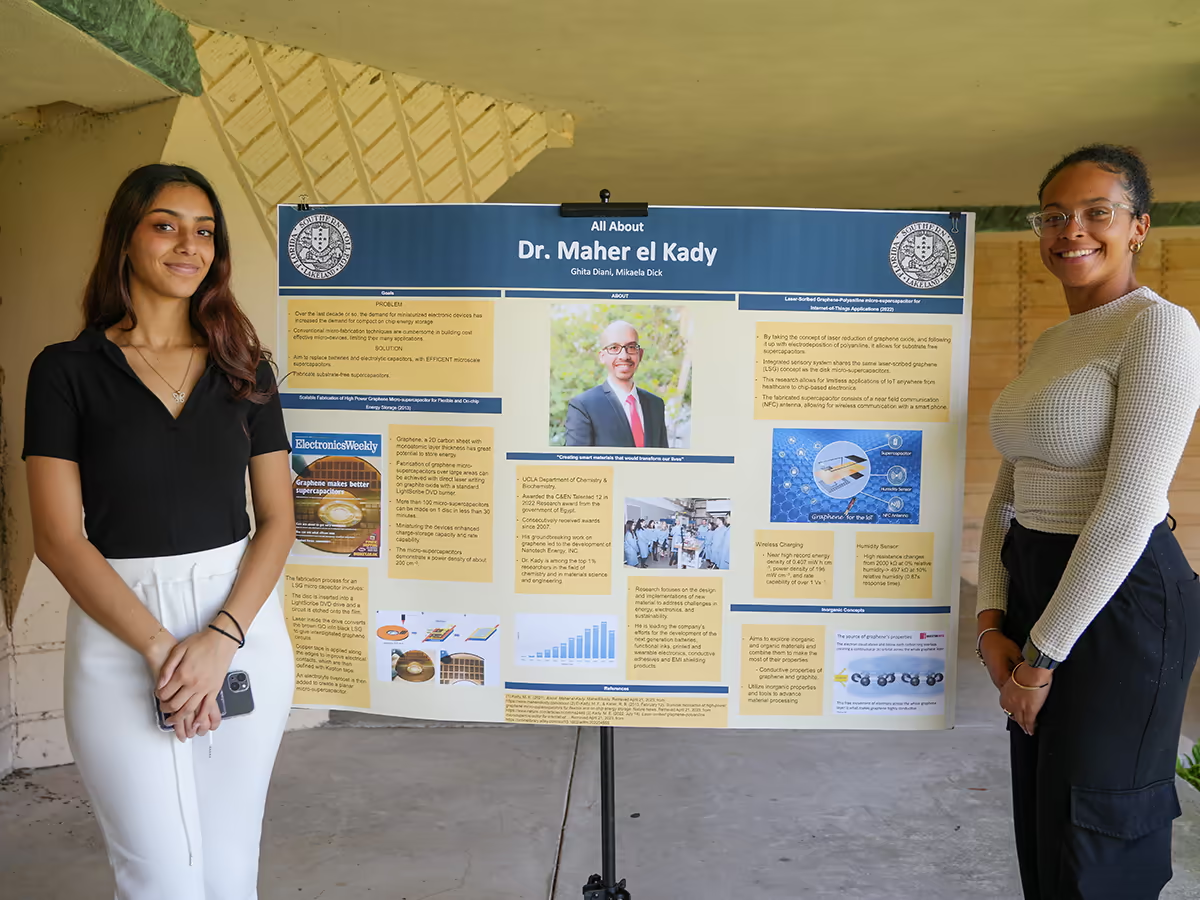
- Research with a mentor. Complete a two-year capstone project alongside a faculty mentor.
- Share your work. Publish original research and present at professional conferences.
- Connect with leaders. Attend Honors-only lectures, symposia, and networking events.
- Take more classes. Enroll in up to 20 credit hours per semester at no extra cost.
- Register early. Get priority registration so you can take the classes you need, when you need them.
- Study in your own space. Use a private Honors student lounge for quiet study and collaboration.
- Live with fellow scholars. Join the Honors Living-Learning Community in your first year.
Your Four Years in Honors
With an emphasis on scholarly inquiry, the Honors College is fully integrated into your existing degree plan, and doesn’t require additional credit hours beyond your major. Instead, it enhances your education through a thoughtfully designed sequence of courses that encourage you to “think big.”
Each stage of the program builds on the last, with opportunities to collaborate across disciplines, conduct original research, and develop a capstone project that reflects your academic journey and ambitions.
- 1
- HON 1700 Writing on Contemporary Social Issues
- HON 1701 Speaking on Contemporary Social Issues
- HON 1990 Honors First Year Seminar
- 2
- Honors Liberal Arts Course
- HON 2990 Honors Second Year Seminar
- 3
- HON 3955, 3956 Honors-Directed Study
- Submit Thesis Proposal and Present Proposal at Fiat Lux
- 4
- HON 4955, 4956 Thesis Writing
- Submit Final Thesis
- Present Thesis at Fiat Lux
Where Honors Students Go Next
Honors graduates have earned some of the most competitive national scholarships and fellowships.
National Science Foundation Graduate Research Fellowship
Jasmine Childress '15 used her fellowship to pursue a Ph.D. in parasitology at the University of Southern California.
Fulbright Scholarship
FSC has been recognized as a Top Fulbright Producer. Political science, economics, and finance graduate Morgan McDermott taught English in Thailand as a Fulbright English teaching assistant.
Goldwater Scholarship
Jake Griner '18 and Zachary Fralish '19 used their awards to research new treatments for retinal disease and chordoma, a rare form of cancer.
Truman Capote Fellowship
English: Writing graduate James McKenna '19 used the fellowship to earn an MFA at the University of Alabama.
Student Voices

"The Honors College has given me incredible opportunities to conduct and present my own research, something I never imagined doing so early in my college career. With the support and guidance of my professors, I’ve been able to dive deeper into the subjects I’m passionate about and gain real experience that will set me apart in graduate school and beyond."
Sophia Brice

For my capstone project, I examined speeches surrounding the Voting Rights Act of 1965 and how Senators utilized rhetorical tools to signal their position. The opportunity allowed me to deeper into a topic I'm passionate about while taking ownership of my education. The process also developed my resiliency. Now, I see roadblocks as opportunities for innovation — a skill I put to use every day.
Gabriella Hesse
Who Should Apply
Honors students are curious, self-motivated, and determined. Many are leaders in their schools and communities. Others are gifted writers, artists, or scientists. They take on challenges, thrive on collaboration, and know that success is built through community.
Requirements to apply
- A minimum 3.5 weighted GPA
- A completed Honors application
- At least three markers of excellence from any of the areas below
You don't need one marker from each area, just three overall. Choose the ones that best show your commitment to excellence.
- Submission of a piece of academic work for the committee to evaluate (examples may include: lab report, research paper, or critical analysis of a creative work)
- National, state, district, or school-wide awards for academics (examples may include: quiz bowl, debate, robotics competitions)
- At least 16 anticipated college credits earned through AP, IB, AICE, or classes at
another college/university (see advanced credit policies)
Advanced Credit Policies - Class rank in the top 10% or top reporting division of your high school
- 1330 SAT or 29 ACT superscore
- Participation in AVID, Upward Bound, GEAR UP, or other college preparatory programs
- EMT, CNA, or other industry certifications
- Demonstrated initiative in an extracurricular setting (applicants who have started new clubs or initiatives, or contributed to new developments or projects within an organization)
- Participation in advocacy or interest groups, partisan or nonpartisan political activities, or community organizing
- Participation in JROTC
- Consistent record of working to improve and give back to your community (participation and leadership in trash pickups, volunteer tutoring, working in a food bank, or other community service work)
- Participation in career-oriented extracurricular activities (DECA, FBLA, FFA, HOSA, or similar)
- Excellence in a challenging skill or trade (e.g., a musical instrument, computer programming, auto repair)
- Submission of creative works (stories, poetry, photography, films)
- Reliable performance in a paid position or volunteer job
- History of acting as a caretaker at home or in the community
- Girl Scout Gold Award, Boy Scout Eagle Scout rank, or similar
- Accomplishments in a school community (applicants who hold leadership positions like school newspaper editor, student council, orientation leaders, or similar)
How to Apply
Submit your Honors application by one of these deadlines below. Decisions are sent about six weeks after each deadline. Every application is evaluated equally, so choose the deadline that works best for you. Space is limited.
There is no extra charge to participate in Honors. Honors applicants may also qualify for Prestige and Premier Scholarships.
January 3
March 1
Already at FSC or Transferring?
Current students: You can apply by the end of your first semester. You'll need a minimum 3.5 GPA and a letter of recommendation from a faculty member.
Transfer students: Transfer students are considered case by case, especially if they were in an honors program at their previous school.

Frequently Asked Questions
Honors classes ask you to think differently, communicate across disciplines, and work closely with faculty. Their interdisciplinary approach connects course material to current events.
Yes. Honors options are available in Accounting, Biology, Chemistry, English, History, Music, Philosophy, Psychology, and Religion. Contact your admissions counselor or academic advisor for details.
Earn a C or higher in all Honors courses and maintain a cumulative GPA of 3.5 or higher to graduate from the Honors College.
The Honors curriculum takes six semesters to complete. If you have enough credit to graduate in less than three full years, consider an honors option in your major instead.
There are no scholarships specifically for Honors College participation, and no extra charges. Honors applicants may qualify for Prestige and Premier Scholarships.
Get in Touch
Questions about the Honors College? Contact Dr. Falcon, or reach out to the Office of Admissions at 863.680.4131 if you're applying.

Silviana Falcon, D.H.A.
Associate Provost for the Honors College and Strategic Business Partnerships, Associate Professor of Business Administration, Tanner Chair in Ethics in Business and Economics
- 863.680.5067
- 863.680.4355
- sfalcon@flsouthern.edu
- Thad Buckner Building