



Skip to main content Skip to main navigation Skip to footer content

Hazing Prevention at FSC

One of the most exciting parts of college life is finding your people and connecting with the many student groups, organizations, and teams that call Florida Southern College home. These groups thrive when they operate in, and support, a culture of care and responsibility.

About

Florida Southern College maintains a strict zero-tolerance policy prohibiting all forms of hazing by any student, organization, or athletic team. The policy covers both on-campus and off-campus activities, and participation is strictly forbidden regardless of an individual's willingness to participate.

Our Mission

To foster a community of involvement and belonging where the group cares for and protects the individual, through education, awareness, and collaboration.

Hazing Defined

Florida Southern College prohibits the following:

  1. Hazing, as defined in Florida Statute 1006.63: "Hazing" means any action or situation that recklessly or intentionally endangers the mental or physical health or safety of a student for purposes including, but not limited to, initiation or admission into or affiliation with any organization operating under the sanction of a postsecondary institution. "Hazing" includes, but is not limited to:

    • brutality of a physical nature, such as whipping, beating, branding, exposure to the elements, forced consumption of food, liquor, drug, or other substance;
    • subjecting a person to extreme mental stress, such as sleep deprivation, forced exclusion from social contact, forced conduct that could result in extreme embarrassment, or other forced activity that could adversely affect the mental health or dignity of a reasonable person;
    • pressuring or coercing a person into violating local, state, federal law and/or College policy;
    • interfering with or impeding a person's academic pursuits, employment, religious observances, or affiliation with other individuals, groups, or activities; or
    • otherwise infringing upon a person's personal or property rights or substantially interfering with a reasonable person's ability to participate in or benefit from the services, activities, or privileges provided by the College.

    Hazing does not include customary athletic events or other similar contests or competitions or any activity or conduct that furthers a legal and legitimate objective.

  2. Soliciting another or aiding or assisting another to engage in any act of hazing as defined in this Code, or active involvement in the planning of such action.
  3. Observing or participating in any conduct defined as hazing pursuant to the Code by a member of the student organization or group who is not themselves a complainant, without reporting the incident to a College official.

The following circumstances do not constitute a defense to allegations of hazing:

  1. the consent of the victim had been obtained;
  2. the conduct or activity that resulted in the death or injury of a person was not part of any official organizational event or otherwise sanctioned or approved by the student organization or group; or
  3. the conduct or activity that resulted in the death or injury of a person was not done as a condition of membership into a student organization or group.

What Is Hazing?

Hazing is related specifically to pledging, being initiated into, developing an affiliation with, holding office in, or maintaining membership in any organization. Hazing is any activity that humiliates, degrades, abuses, or endangers a person, regardless of that person's willingness to participate.

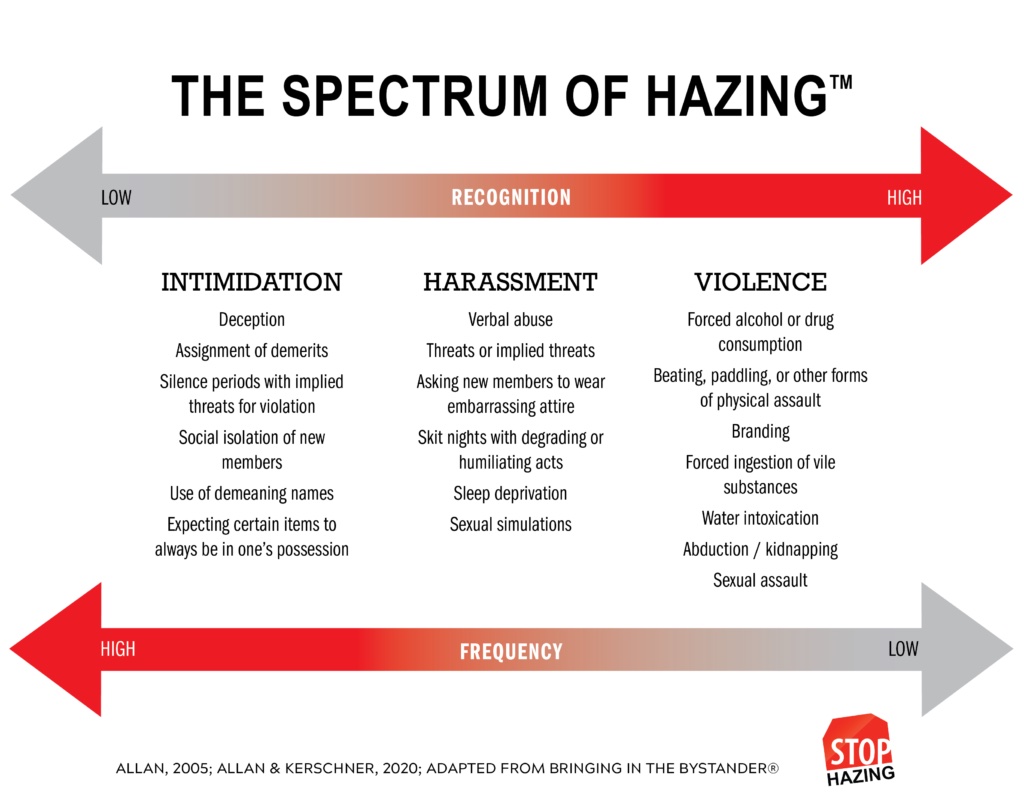
Hazing can look like many different behaviors, and it often happens along a spectrum. Some behaviors, like violence, are easy to recognize but happen less often. Others, like intimidation and harassment, happen more often and are easier to overlook. All of them are hazing.

The Spectrum of Hazing, showing hazing behaviors grouped into intimidation, harassment, and violence. Intimidation is the most common and least recognized; violence is the most recognized and least common. Full list below.
The Spectrum of Hazing. Allan, 2005; Allan & Kerschner, 2020; adapted from Bringing in the Bystander. Courtesy of StopHazing.
View the Spectrum of Hazing as Text
Intimidation
  • Deception
  • Assignment of demerits
  • Silence periods with implied threats for violation
  • Social isolation of new members
  • Use of demeaning names
  • Expecting certain items to always be in one's possession
Harassment
  • Verbal abuse
  • Threats or implied threats
  • Asking new members to wear embarrassing attire
  • Skit nights with degrading or humiliating acts
  • Sleep deprivation
  • Sexual simulations
Violence
  • Forced alcohol or drug consumption
  • Beating, paddling, or other forms of physical assault
  • Branding
  • Forced ingestion of vile substances
  • Water intoxication
  • Abduction or kidnapping
  • Sexual assault

Anywhere on this spectrum, hazing can look like any action that seeks to:

  • Humiliate, intimidate, or degrade a person.
  • Create physical or emotional discomfort.
  • Endanger a student's health or safety.
  • Interfere with academic responsibilities.
  • Require new members to perform duties or tasks because of their status, such as running errands, carrying items, or other servitude-type activities.
  • Create distinctions between initiated and uninitiated members through coercive or degrading treatment.

Even if an activity seems harmless or is described as a longstanding tradition, it could still be hazing. If you're unsure, ask yourself these questions:

  • Are all members participating in this activity, or is it only for certain members of the organization?
  • Is there a question whether this activity can be conducted safely, or is there a risk of injury?
  • Would you freely discuss the activity with your parents, a professor, or other College staff members?
  • Are alcohol or drugs involved in this activity?
  • Does the activity intentionally cause pain or emotional harm to the people participating?
  • If a photo or video of the activity surfaced on social media or in the news, would you feel embarrassed, upset, or ashamed?

If the answer to any of these questions is "yes," the activity is likely hazing.

Hazing Policy & Law

Read Florida Southern College's hazing policy, Florida Statute 1006.63, and the federal Stop Campus Hazing Act, including how each defines and prohibits hazing.

It is a violation for students, faculty, staff, or alumni to engage in any activity that may be construed as hazing on or off campus. Hazing is any action taken or situation created that produces mental, emotional, or physical discomfort, embarrassment, harassment, or ridicule.

Such activities and situations include, but are not limited to:

  • Paddling in any form
  • Creation of excessive fatigue
  • Physical and psychological shocks
  • Treasure hunts, scavenger hunts, and road trips
  • Wearing apparel that is conspicuous and not normally in good taste
  • Engaging in public stunts
  • Morally degrading or humiliating games and activities that call undue attention to a difference in status between initiated and non-initiated members, such as running errands or carrying food trays
  • Late work sessions that interfere with scholastic activities, regulations, and policies of Florida Southern College

Violations by individuals or student groups constitute grounds for disciplinary action. The policy on hazing applies to all campus organizations.

Under Florida law, hazing is prohibited and defined by Florida Statute 1006.63. The law applies to student organizations at colleges, universities, and other postsecondary institutions. Florida defines hazing as any action or situation that intentionally or recklessly endangers a student's mental or physical health or safety for purposes such as:

  • Initiation into an organization
  • Admission to an organization
  • Affiliation with an organization
  • Continuing a tradition or ritual of an organization

The key takeaway is that hazing in Florida is not limited to physical abuse. Any tradition, initiation, bonding activity, or organizational ritual that intentionally or recklessly endangers a student's physical health, mental health, safety, or dignity may constitute hazing, even if participants consent and even if the activity occurs off campus. Serious cases can result in felony charges, organizational sanctions, and institutional discipline.

The Stop Campus Hazing Act (S.2901, H.R.5646), enacted on Dec. 23, 2024, amends the Jeanne Clery Campus Safety Act to prioritize the prevention of, and transparency about, hazing incidents at colleges and universities. The federal law defines hazing as follows:

The term "hazing," for purposes of reporting statistics on hazing incidents, means any intentional, knowing, or reckless act committed by a person (whether individually or in concert with other persons) against another person or persons regardless of the willingness of such other person or persons to participate, that:

  • Is committed in the course of an initiation into, an affiliation with, or the maintenance of membership in, a student organization; and
  • Causes or creates a risk, above the reasonable risk encountered in the course of participation in the institution of higher education or the organization, of physical or psychological injury including:
    • Whipping, beating, striking, electronic shocking, placing of a harmful substance on someone's body, or similar activity;
    • Causing, coercing, or otherwise inducing sleep deprivation, exposure to the elements, confinement in a small space, extreme calisthenics, or other similar activity;
    • Causing, coercing, or otherwise inducing another person to consume food, liquid, alcohol, drugs, or other substances;
    • Causing, coercing, or otherwise inducing another person to perform sexual acts;
    • Any activity that places another person in reasonable fear of bodily harm through the use of threatening words or conduct;
    • Any activity against another person that includes a criminal violation of local, State, Tribal, or Federal law;
    • Any activity that induces, causes, or requires another person to perform a duty or task that involves a criminal violation of local, State, Tribal, or Federal law.

Report Hazing

If you have experienced or witnessed any form of hazing, you are encouraged to report it. Reporting is an important step in helping our campus remain safe and secure for all students.

Anonymous reporting: You may submit a report anonymously by leaving your name and contact information blank on the form. This is the only way to ensure anonymity. However, please be aware that the College may be unable to complete an investigation or hold students or organizations accountable without the ability to share and evaluate the source of the report for credibility.

Rick Gebauer

Rick Gebauer

Director of Student Conduct

Amanda Blount

Amanda Blount, Ed.D.

Assistant Dean of Student Support

Once a report is filed, it is reviewed by the Office of Student Conduct staff, and an investigation is conducted.

  1. An investigator contacts the complainant to schedule an interview. The complainant may bring a support person to the interview and may offer witnesses and evidence to support their account.
  2. After the complainant's interview, a formal letter of complaint is sent to the organization detailing the nature of the allegations. This letter may also go to connected parties, such as group advisors and contacts at national organizations.
  3. Interviews are conducted with the other parties involved. Respondents may also offer witnesses and evidence to support their account.
  4. After all interviews are complete, the investigator makes a determination.
  5. The outcome, and any sanctions if the organization is found responsible, is communicated to the organization.

All investigations are conducted in a timely manner with the goal of a thorough and swift resolution. The timeframe can vary depending on case complexity, witness scheduling, and current caseload.

Under the Florida Southern College Student Handbook, hazing violations may result in serious disciplinary action, including:

  • Educational sanctions
  • Conduct probation
  • Loss of privileges
  • Suspension of organizations
  • Individual suspension from the College
  • Expulsion from the College

Student organizations may also be sanctioned as a group, independent of action taken against individual members.

Prevention

Coordination of Campus Partners

Hazing affects all of us. Prevention efforts are guided by the Office of Student Conduct in partnership with campus offices, including Campus Safety and Security, Health and Wellness, Athletics, and Student Involvement.

Leaders of student organizations, including fraternities and sororities, are also included in awareness and prevention efforts.

Education

Online Training

Florida Southern College partners with Vector Solutions to provide a mandatory hazing prevention training module for all incoming students. The module helps students recognize hazing, understand its dangers, and take steps to prevent it, and it ensures FSC meets the requirements of the Stop Campus Hazing Act and Florida law. Training modules are also available for faculty and staff.

In-Person Presentations

In-person presentations on hazing prevention are available for all student clubs, organizations, and teams upon request. These sessions are facilitated by a staff member of the Office of Student Conduct. Presentations on bystander intervention are also available.

Presentations may also be facilitated by a third-party organization with expertise in hazing awareness and education, in coordination with the Office of Student Conduct.

National Hazing Prevention Week

Florida Southern College observes National Hazing Prevention Week (NHPW), an annual campaign organized by the Hazing Prevention Network to raise awareness about the dangers of hazing and promote a culture of respect and safety within communities, schools, and organizations. The week is traditionally observed during the last full week of September.

Learn More About National Hazing Prevention Week

Learn More From National Organizations

These organizations offer research, training, and awareness materials for students, families, and educators who want to understand hazing and help prevent it.

  • StopHazing: Research-based hazing prevention resources, including the Spectrum of Hazing featured on this page
  • Hazing Prevention Network: Education and awareness programs, and the organizer of National Hazing Prevention Week
  • Clery Center: A national nonprofit focused on campus safety, including resources on the federal hazing reporting requirements

Confidential Resources

These resources can listen and help without notifying the College.

FSC Counseling Center

First floor of the Thrift Building

The Counseling Center offers students walk-in access to clinical services, no appointment needed, Monday through Friday, 8 a.m. to 5 p.m.

863.680.6236
counseling@flsouthern.edu

After-hours support: To reach the FSC on-call counselor or have an officer dispatched, call 863.680.4305. In an emergency, call 911.

Chaplain's Office

Fannin Center

Students of all faiths, or no faith at all, are welcome at the Fannin Center to receive free spiritual direction and pastoral counseling from the Chaplain's Office staff. Pastoral counseling meetings are confidential and can be arranged in person or by email, based on the student's needs and schedule.

863.680.4297
twright@flsouthern.edu

Non-Confidential Resources

These offices can help you report hazing and connect you with support. Information you share may be passed on to the College officials who respond to reports.

Campus Hazing Transparency Report

In compliance with federal campus safety reporting requirements, Florida Southern College provides this Campus Hazing Transparency Report to share information about past hazing misconduct involving fraternity and sorority organizations.

The report includes the name of the organization, the dates of the alleged hazing behavior (if known), the date the behavior was reported to the College, the dates of the investigation and final determination, and a summary of the findings. Where applicable, the report also notes whether the violation involved the abuse or illegal use of alcohol or drugs and the date the organization was notified of the finding of responsibility.

Only incidents that have completed the College's conduct process and resulted in a finding of responsibility are included. Reports of hazing that did not result in a finding of responsibility are not published. Unless otherwise noted, the date of the finding of responsibility corresponds to the date notice was provided to the organization. Student organizations under active investigation do not appear on this report.

This report is updated twice each year, typically before the start of the fall and spring semesters, and information is maintained for the period required by federal law.

Annual hazing statistics are published separately in Florida Southern College's Annual Security and Fire Safety Report, in accordance with federal law. These statistics reflect reported incidents that meet the federal definition of hazing and do not necessarily indicate findings of responsibility.

For more on FSC's hazing policy, prevention efforts, and reporting resources, see Hazing Prevention above.

2025-2026 Academic Year

No hazing was reported or investigated.

2024-2025 Academic Year

No hazing was reported or investigated.