ROTC FAQs
About the Program
Army Reserve Officers' Training Corps (ROTC) is a college program that develops the future officer leadership of the U.S. Army. The program combines a Military Science minor with leadership development, physical training, and hands-on experiences. Cadets graduate ready to commission as Second Lieutenants in the U.S. Army, Army Reserve, or Army National Guard, or to carry their leadership training into civilian careers.
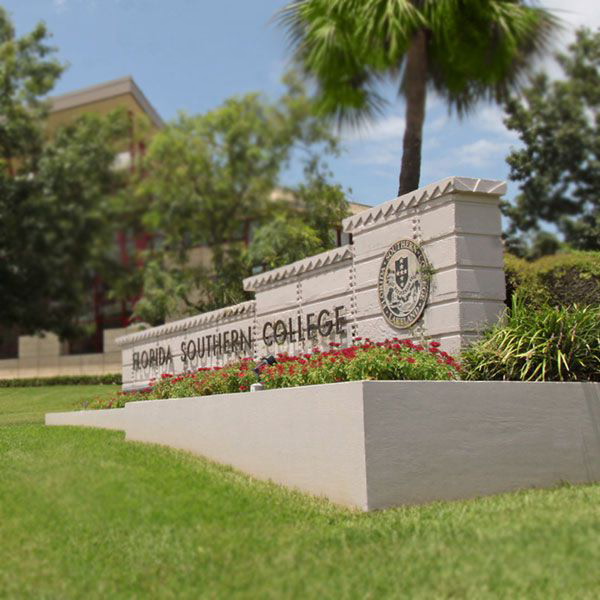
The Moccasin Battalion is Florida Southern College's Army ROTC program. Established in 1951, it's one of the oldest ROTC programs in the state and partners with Southeastern University and Polk State College. Cadets can be enrolled at any of the three institutions while training together at Florida Southern.
The Mocs Battalion has been ranked in the top 10% of ROTC programs nationally and consistently performs above its size in competition. Alumni include nine General Officers and leaders across government, business, and military service worldwide. The program's three-school partnership also gives cadets a uniquely collaborative training environment.
No. The Basic Course (the first two years of ROTC, freshman and sophomore years) carries no service obligation. You can take it for up to two years and decide whether to continue. Once you continue into the Advanced Course (junior and senior years) or accept a scholarship, you commit to commissioning and serving after graduation.
Eligibility and Joining
To contract with the Mocs Battalion, you must be a U.S. citizen or permanent resident, full-time enrolled at Florida Southern, Southeastern University, or Polk State College, at least 17 years old, and under 31 in your year of commissioning. You'll also need to pass the Army Fitness Test (AFT) and the DoDMERB Physical, and meet the Army's height and weight standards.
No. The Mocs Battalion welcomes cadets from Florida Southern, Southeastern University, and Polk State College. You'll be enrolled at one of the three partner institutions and train with the battalion at Florida Southern.
For some parts of the program, yes. Army ROTC scholarships and commissioning as an officer require U.S. citizenship. Lawful permanent residents (green card holders) may enroll in the Basic Course (the first two years of ROTC) with no service obligation, but cannot contract for a scholarship or enter the Advanced Course without U.S. citizenship.
You must be at least 17 to begin and under 31 in your year of commissioning. The Advanced Course commitment locks in your commissioning year, so the maximum starting age depends on how many years you have left in your degree.
Time Commitment and Daily Life
Yes. Mocs Battalion cadets are full members of the Florida Southern community. Many cadets compete in NCAA athletics, join clubs, participate in fraternities and sororities, study abroad, and take on jobs alongside their ROTC commitments. Coordination with ROTC leadership is key, especially for student-athletes. ROTC training is designed to fit alongside your other commitments, not replace them.
Scholarships and Costs
No. ROTC scholarships are awarded on merit, including academic performance, leadership potential, and physical fitness. Financial need is not a factor.
Yes. The Campus-Based Scholarship is awarded by the Mocs Battalion's own scholarship board to students already enrolled at Florida Southern, Southeastern, or Polk State who are already participating in ROTC. Eligibility is based on your performance in the program and your academic standing. See the Enrollment page for more details.
Taking Military Science classes during the Basic Course (freshman and sophomore years) carries no obligation. You can enroll in MSL 1001, 1002, 2001, and 2002 and decide whether ROTC is right for you. Contracting is the formal agreement to enter the Advanced Course (junior and senior years) and commission as an Army officer after graduation. Contracting comes with benefits, including scholarship eligibility and the monthly stipend for Advanced Course cadets, and the corresponding service commitment.
After Graduation
For National Scholarship recipients, the commitment is eight years total: four years of full-time service plus four years in the Individual Ready Reserve (IRR). Some cadets choose to serve part-time in the Army Reserve or Army National Guard while pursuing a civilian career, which has different commitment terms.
Graduates commission into one of the Army's officer career fields, including infantry, intelligence, cyber, aviation, medical, engineering, military police, finance, communications, and many others. The Army has multiple branches where commissioned officers serve, and your branch is determined through a combination of your preferences, your performance, and Army needs.
Yes. Many cadets pursue graduate or professional school after commissioning, either by deferring active duty service through programs like Educational Delay or by serving first and pursuing professional school later. Specific paths exist for cadets interested in becoming Army lawyers (JAG Corps), Army doctors (Health Professions Scholarship Program), and Army chaplains. The best first step is a conversation with your cadre to plan your pathway.
You can serve part-time in the Army Reserve or Army National Guard while pursuing a civilian career. Many cadets graduate, commission, and then take a part-time service path alongside law school, medical school, or a civilian job.
Yes. Cadets have two layers of career support: Army-wide programs and Florida Southern's own. Through the Army Partnership for Youth Success (PaYS) program, the Army connects cadets with civilian employers who guarantee job interviews after military service. At Florida Southern, ROTC cadets also have full access to FSC Career Services for resume and interview support, internship search help, networking events, and graduate school planning. Between PaYS, FSC Career Services, and the Mocs Battalion's own mentorship, you graduate with multiple paths into your next step.
Still Have Questions?
The best way to get a specific answer is to talk to someone on our team. Request information and we'll connect you with a recruiter who can walk you through your specific situation.