

Frequently Asked Questions
Getting Started
You are never required to disclose a disability, and by federal law the College cannot ask about one on the application. That said, if you believe a disability affected your grades or test scores in a way that does not reflect your ability to do college-level work, you may choose to explain that to the admission office. It is a personal decision, and one worth talking over with people you trust, a parent, school counselor, or vocational rehabilitation counselor. Once you are accepted, it is up to you to contact Student Disability Services to set up accommodations.
Under the Americans with Disabilities Act and Section 504 of the Rehabilitation Act, a disability is a mental or physical impairment that substantially limits one or more major life activities.
Under Section 504, it means being unable to perform a major life activity, such as caring for yourself, walking, seeing, hearing, speaking, breathing, learning, or working, or being significantly restricted in how you can perform it compared to most people.
Accommodations and Classes
The College is responsible under federal law for ensuring access to its programs, and SDS has the training, credentials, and experience to determine what counts as a reasonable accommodation that provides equal access. We use the documentation you provide as a basis for those decisions, but we are not required to match a provider's recommendation exactly. Our goal is an accommodation that gives you fair access while keeping your program's academic standards intact.
No. Unlike high school, FSC does not offer special programs or remedial courses. You are encouraged to use the academic support available to all students, including your academic advisor and the Center for Student Success.
You choose which instructors to share your accommodations with. With your permission (a Consent Waiver), your instructors receive an email with your name and your Accommodation Plan. SDS will not discuss your diagnosis with any faculty or staff member unless you sign a release of information form.
We send your Accommodation Plan to all your instructors and copy you on that email, so you know they have received it. From there, it is your responsibility to talk with each instructor about how each accommodation will work in their class.
Service and Emotional Support Animals
Yes. Under the Americans with Disabilities Act, a service animal is a dog individually trained to do work or perform tasks for a person with a disability. Service animals are welcome across campus. An animal that poses a direct threat to health or safety, or is disruptive, may be excluded regardless of training. To keep a service animal in campus housing, you will also need to provide documentation such as rabies verification, county license, and proof of ownership.
Emotional support animals are different from service animals. They are allowed in campus housing as an approved accommodation, but not in other campus buildings, and they must be approved before they arrive. There is no fee for an approved emotional support animal. You request one through the registration process.
Getting Around Campus
Yes. We offer on-campus transportation through Mocs Movers and shuttles, and FSC also runs shuttles to the Tampa and Orlando airports. Campus Safety offers escort services after dark.
Campus accessibility varies by location, and alternative accessible routes are available to help students reach academic and student spaces. Student Disability Services is available to discuss individual access needs and provide information about available accommodations and resources.
Get in Touch
Still have questions? We are here to help.

Sandy Calvert, Ph.D.
Assistant Dean for Student Disability Services
- 863.680.3952
- 863.616.6468
- disabilityservices@flsouthern.edu
- Rogers Building - 244
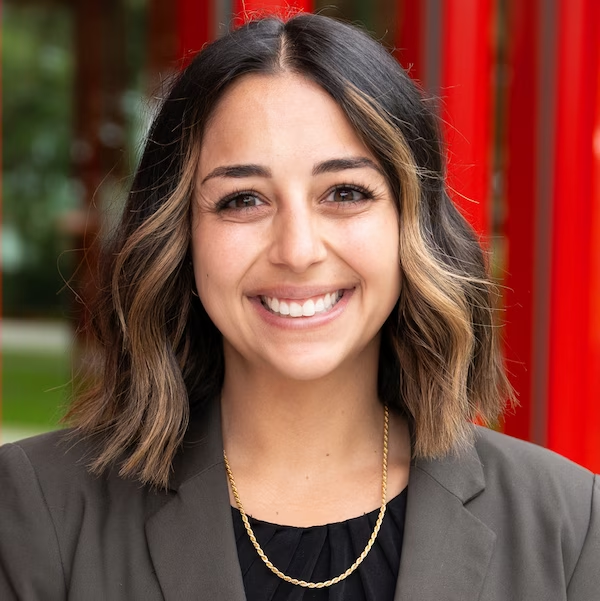
Amanda Koester
Disability Services Access Coordinator
- 863.680.3952
- 863.680.4197
- disabilityservices@flsouthern.edu
- Rogers - 243